
How to Build an MVP That Actually Works — A No-Code Founder's Guide
Jahanzeb Khan
Founder
12 min read
Most founders think building an MVP means building a smaller version of the final product.
That's usually where things start going wrong.
They spend months building dashboards nobody uses, features nobody asked for, and workflows that looked good in a spreadsheet but fall apart the moment a real user touches the app.
Then they launch. Silence. No traction. No retention. Just another abandoned MVP sitting on a custom domain.
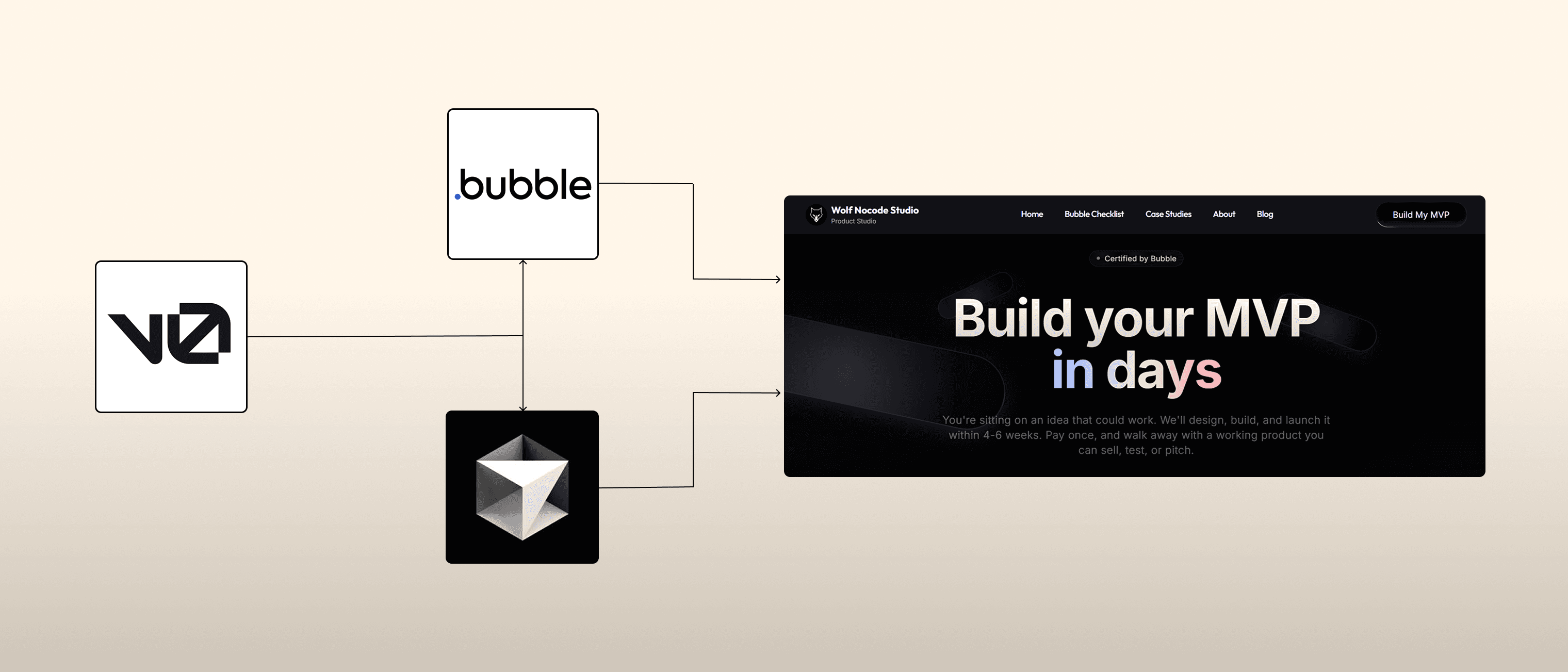
After building 25+ products using Bubble, Cursor, v0, and AI workflows since 2020, I've come to one conclusion:
The best MVPs are not the smallest products. They're the fastest path to learning.
Once founders understand that properly, everything changes.
What is an MVP — and what it actually isn't
An MVP — minimum viable product — is not a broken prototype, a rushed landing page, or your full product with 14 features removed.
An MVP is the fastest possible way to validate a real problem with real users.
Its purpose is to answer questions:
- Do users actually want this?
- Will they use it consistently?
- What part of the product matters most?
- Would anyone pay for this?
The problem is that most founders start building before they have answers to any of those questions.
Why most MVPs fail
Most founders build backwards.
They start with dashboards, AI integrations, onboarding flows, payment systems, and scalability discussions — before validating whether anyone even wants the core product.
I've seen founders spend 4–6 months building and $10,000–$50,000 on development, only to launch and realise nobody cares.
The issue isn't Bubble. The issue isn't no-code. The issue is simple:
They built a product before validating the problem.
That mistake kills startups constantly. And it's entirely avoidable.
How long does it take to build an MVP?
This is one of the most searched questions founders ask — and the answer nobody gives honestly.
With traditional development: 4–9 months minimum for a properly built product.
With no-code tools like Bubble, Lovable, and v0: 6–10 weeks for most products. Simple single-workflow apps can launch in 3–4 weeks. Complex multi-sided platforms or AI-powered products typically run 8–12 weeks.
The variable isn't the platform. It's the planning that happens before anyone opens a builder.
At Wolf Nocode Studio, the founders who launch fastest are the ones who arrive with a clear problem statement — not a feature list.
How much does it cost to build an MVP in 2025?
MVP development costs vary significantly depending on complexity, who builds it, and which tools are used.
| MVP Type | Typical Cost |
|---|---|
| DIY on Bubble or Lovable | $0–$500 (your time) |
| Junior freelancer build | $500–$3,000 |
| Experienced solo Bubble developer | $3,000–$8,000 |
| No-code agency, full build | $8,000–$20,000+ |
| Traditional development agency | $30,000–$150,000+ |
The important thing to understand: cheap MVPs almost always become expensive rebuilds.
Bad architecture creates technical debt, poor UX, slow iteration cycles, and a product that breaks at scale. The cost of fixing a badly built MVP is almost always higher than building it right the first time.
At Wolf Nocode Studio our MVP builds run between $8,000–$15,000 for most founder projects — significantly faster and more affordable than traditional development, without the shortcuts that haunt you at Series A.
The MVP formula that actually works
At Wolf Nocode Studio this is the framework we use across every product we build:
Pain + Core Action + Feedback Loop
Simple. But almost every successful product follows this exact structure.
Step 1 — Find a pain worth solving
This is where good products begin. Not trends. Not hype. Not "AI startup ideas."
Pain.
The best MVPs solve something annoying, repetitive, expensive, time-consuming, or manual. The stronger the pain, the easier the validation.
This is why some tiny, boring SaaS products quietly make millions while flashy startup ideas disappear in six months. One solves a painful problem. The other solves nothing.
Most founders think features create value. They don't. Solving pain creates value.
A founder will come to us wanting dashboards, user roles, notifications, complex automations, advanced admin panels, and AI integrations everywhere. Then we ask:
"What is the one thing your user actually needs?"
Usually there's a long pause. That's the real problem. If the founder doesn't know the core value, the user definitely won't.
Step 2 — Find the core action
Every successful product revolves around one core action.
| Product | Core Action |
|---|---|
| Airbnb | Booking a stay |
| Uber | Requesting a ride |
| Stripe | Accepting payments |
| Notion | Organising information |
| Slack | Team communication |
Your MVP should optimise one thing exceptionally well. Not ten things badly.
A good MVP should almost feel uncomfortable to launch — because founders always want to add more. Resist it. The market will tell you what to add next. Build the minimum that lets it do that.
Step 3 — Build feedback loops from day one
Most founders launch products with no proper feedback systems. That's the third and final failure mode.
Your MVP should be designed around learning from the moment it goes live. That means:
- Analytics tracking from day one — not added later
- User onboarding tracking — where do people drop off?
- In-app feedback forms — make it easy to tell you what's broken
- User interviews scheduled in the first two weeks post-launch
- Retention analysis — who comes back, and why?
Your first version will not be correct. That's not a failure — it's the point. The goal is speed of learning, not perfection of output.
How to build an MVP with no-code tools
No-code has permanently changed what's possible for founders without engineering teams. Here's how we approach it at Wolf Nocode Studio.
Before we open any builder, we define:
- The user problem in one sentence
- The core user journey from signup to main action
- Feature priorities — what's essential vs what's nice to have
- Product positioning — who is this for and why will they choose it
We use Claude and ChatGPT heavily in this phase. Not to replace thinking — to accelerate it.
Then we move into design.
Tools like v0 have completely changed our prototyping process. Instead of spending weeks manually designing interfaces, we use AI-assisted workflows to rapidly generate layouts, design systems, onboarding flows, and dashboards. Founders see what their product looks like before a single workflow is built.
Then we build inside Bubble.
With the UX decided and approved, we build intentionally instead of improvising screen by screen. This is the single biggest difference between a Bubble app that feels polished and one that feels like it was built by someone making it up as they went.
The no-code MVP stack we use most in 2025:
- Bubble — full-stack web apps, databases, workflows, user authentication
- v0 — rapid UI prototyping and component generation
- Cursor — AI-powered development for custom logic
- n8n — automation workflows and integrations
- Figma — design and UX before build
The biggest mistake we see in no-code MVP builds
Honestly? Most Bubble apps fail because the founder starts building workflows before designing the user experience.
They open Bubble, drag elements around, adjust spacing randomly, and add workflows as they think of them. Three months later the product feels bloated, confusing, inconsistent, and impossible to scale.
This is why so many no-code apps feel terrible to use. No UX thinking happened before development started.
The fix is simple: design before you build. Get every screen approved in Figma or as a v0 prototype before a single workflow is written. It adds a week to the process and saves months of rebuilding.
Can Bubble scale for a real business?
Yes — and this question comes up in almost every founder conversation we have.
Our largest live product serves 8,000+ active users and was built entirely on Bubble. It handles real-time data, complex user roles, location-based features, and integrated messaging — at scale, reliably, every day.
Bubble is SOC 2 Type II compliant, hosted on AWS with Cloudflare protection, and GDPR-ready. With the right architecture it handles thousands of concurrent users without issue.
The platform isn't the variable. The architecture is. A badly designed Bubble app struggles at 50 users. A well-designed one handles 50,000.
Most startups don't reach a point where they need to migrate off Bubble before Series B. And when they do, we help them plan the transition.
AI is changing how MVPs get built
The combination of Bubble, Cursor, Claude, v0, and AI workflows has fundamentally changed what small teams can ship.
Founders who would have needed a 5-person engineering team in 2020 can now build and launch production-ready products with one experienced no-code developer and the right AI toolstack.
At Wolf Nocode Studio we use AI throughout the product lifecycle — PRDs, feature planning, UX exploration, workflow structuring, prototyping, and iteration cycles. This doesn't remove the need for skill. It amplifies skilled builders.
The startups winning right now aren't the ones with the biggest teams. They're the fastest learners with the leanest builds.
Frequently asked questions about MVP development
What does MVP stand for?
MVP stands for minimum viable product — the simplest version of a product that lets you validate a real problem with real users before investing in full development.
How much does it cost to build an MVP?
MVP costs range from $3,000 for a simple single-workflow app to $20,000+ for a complex multi-sided platform or AI-powered product. At Wolf Nocode Studio our MVP builds typically run $8,000–$15,000 using no-code and AI tools — significantly faster and more affordable than traditional development.
How long does MVP development take?
With no-code tools like Bubble, most MVPs ship in 6–10 weeks. Simple products launch in 3–4 weeks. Complex platforms with multiple user types and AI features typically take 8–12 weeks. Timeline depends on complexity and how clearly the problem is defined before build starts.
Can you build an MVP with no-code?
Yes — and for most early-stage founders it's the best approach. Bubble, Lovable, and v0 let you build and launch a production-ready MVP in weeks rather than months, at a fraction of traditional development cost, with the ability to iterate fast based on real user feedback.
What is the difference between an MVP and a prototype?
A prototype is a non-functional model used for testing design and user experience — nobody actually uses it for real tasks. An MVP is a working product real users can actually use. It has functionality, real data, and feedback loops built in from the start.
Should my MVP be built for investors or users?
Users first, always. An MVP built to impress investors looks polished but teaches you nothing. An MVP built around a real user problem generates the traction, retention data, and genuine feedback that actually impresses investors — because it's evidence, not theatre.
What's the first step to building an MVP?
Define the problem before you define the product. Write one sentence that describes who has the problem, what the problem is, and why existing solutions don't solve it well enough. If you can't write that sentence clearly, you're not ready to build yet. If you can — you're further ahead than most founders who come to us.
Want help building your MVP?
At Wolf Nocode Studio we help founders and enterprise teams design, build, and launch AI-powered no-code products — using Bubble, v0, Cursor, Lovable, and n8n.
Whether you're building a SaaS product, marketplace, AI tool, internal platform, or startup MVP — we'll scope it honestly, price it fairly, and ship it in weeks.
Jahanzeb Khan is the founder of Wolf Nocode Studio. He has built 25+ no-code and AI-powered products since 2020 for funded startups, enterprise teams, and first-time founders — using Bubble, v0, Cursor, Lovable, and n8n.
In This Article
Ready to build something
worth talking about?
Whether you've got a full brief or just an idea on a napkin, let's spend 20 minutes figuring out if we're the right fit. No pitch, no pressure.
- ✓ $10M+ Raised by our clients
- ✓ 25 Products shipped
- ✓ 6 yrs No-code expertise
- ✓ 8 wks Avg. time to live